
Emotion grid
An emotion grid is a map of feeling words arranged by two dimensions: energy from low to high, and pleasantness from unpleasant to pleasant.
Point at a cell to see. Click, tap, or use the arrow keys to keep a choice.
The 7×7 affect grid: pick a cell to name a feeling
Furious, raging
About as much energy as you carry, and it feels about as bad as it gets.
Anger at full volume: your body is ready to act and nothing about it feels good. One step down, Angry, tense leaves a little more room between the feeling and what you do next.
Anxious, tense
About as much energy as you carry, and it feels bad.
A lot of energy held in place by worry about what might happen. Restless, on edge has the same charge with less dread in it.
Restless, on edge
About as much energy as you carry, and it leans unpleasant.
Too much energy and nowhere for it to go. It leans unpleasant without the clear worry of Anxious, tense; one row down, Jittery, antsy is the same itch at lower volume.
Wired, buzzing
About as much energy as you carry, and it sits neither pleasant nor unpleasant.
Running fast, but the feeling itself is neither good nor bad, like a late night that hasn’t caught up with you yet. Lean pleasant and it becomes Eager, pumped; lean unpleasant and it becomes Restless, on edge.
Eager, pumped
About as much energy as you carry, and it leans pleasant.
Energy with a direction: you want to start, go, get on with it. Close to Thrilled, lively, but more about what’s ahead than what’s happening now.
Thrilled, lively
About as much energy as you carry, and it feels good.
A big, good charge, often when something you hoped for actually happens. Ecstatic, glowing is the very top; Excited, upbeat is the same pleasure with a little less intensity.
Ecstatic, glowing
About as much energy as you carry, and it feels about as good as it gets.
As much energy as you carry, and as good as it gets: one step past Thrilled, lively. Usually tied to a moment, such as news, a reunion or a finish line, so it’s worth writing down what led here.
Angry, tense
High energy, and it feels about as bad as it gets.
Something feels wrong and you have the energy to push back. Less charged than Furious, raging and hotter than Irritated, edgy; there is often a clear “this isn’t fair” behind it.
Stressed out
High energy, and it feels bad.
High energy spent on pressure: too much to do, too little time, too many people needing something. In everyday speech stress points at a demand that’s here now, while Anxious, tense leans toward what might happen.
Jittery, antsy
High energy, and it leans unpleasant.
Small, fast energy that won’t settle: hard to sit still, easy to fidget. Next to it, Keyed up is the same activation without the discomfort.
Keyed up
High energy, and it sits neither pleasant nor unpleasant.
Switched on and waiting, the way you feel before a call, a game or a performance. Nervous and excited start here with the same energy; how it feels tips it toward Jittery, antsy or Excited, upbeat.
Driven, focused
High energy, and it leans pleasant.
Energy you can aim. Pleasant in a quiet way, more about getting something done than enjoying it; Motivated, ready is the same direction with a little less fuel.
Excited, upbeat
High energy, and it feels good.
High energy that feels good, often about something coming up or just happening. Compared with Keyed up, the anticipation has turned pleasant.
Elated, joyful
High energy, and it feels about as good as it gets.
Strong, bright happiness with plenty of energy behind it. A step below Ecstatic, glowing, and more lit up than Happy, warm.
Irritated, edgy
A little more energy than usual, and it feels about as bad as it gets.
Small things land harder than they should, and patience runs short. Less heat than Angry, tense; the trigger is often a pile of little things rather than one big one.
Frazzled, frayed
A little more energy than usual, and it feels bad.
Stretched thin, with just enough energy to keep going. Less pressure than Stressed out, and more worn than Unsettled, tense.
Unsettled, tense
A little more energy than usual, and it leans unpleasant.
Something is off and you can’t quite name it. A mild unease rather than the sharper worry of Anxious, tense.
Alert, engaged
A little more energy than usual, and it sits neither pleasant nor unpleasant.
Awake, paying attention, ready for what’s in front of you. Neutral in feel: Motivated, ready adds a pleasant pull, Unsettled, tense adds unease.
Motivated, ready
A little more energy than usual, and it leans pleasant.
A pleasant readiness to start. Less charged than Driven, focused, and more forward-looking than Cheerful, light.
Cheerful, light
A little more energy than usual, and it feels good.
A good mood with a bit of bounce, easy to share with other people. Calmer than Excited, upbeat and livelier than Pretty good.
Happy, warm
A little more energy than usual, and it feels about as good as it gets.
Clearly good, with a little extra energy, often around people or something that went well. One row up is Elated, joyful; one row down, Really good is the same warmth held more steadily.
Fed up
An ordinary amount of energy, and it feels about as bad as it gets.
Ordinary energy, but you’ve had enough of something. Not as hot as Irritated, edgy; it often sounds like “this again.”
A bit bothered
An ordinary amount of energy, and it feels bad.
Something is bugging you, but it isn’t running your day. A milder relative of Fed up, and worth a note about what it was before it fades.
Slightly off
An ordinary amount of energy, and it leans unpleasant.
Not bad exactly, just not right. The smallest step from Right in the middle toward unpleasant: hard to describe and easy to forget.
Right in the middle
An ordinary amount of energy, and it sits neither pleasant nor unpleasant.
Neither good nor bad, neither tired nor charged; Doing okay and Slightly off are one small step to either side. A real answer in its own right: middle days show what ordinary looks like for you.
Doing okay
An ordinary amount of energy, and it leans pleasant.
Slightly on the good side, with ordinary energy. Fine and steady, a step short of Pretty good.
Pretty good
An ordinary amount of energy, and it feels good.
A good, regular day. Steadier than Cheerful, light; one step more pleasant is Really good.
Really good
An ordinary amount of energy, and it feels about as good as it gets.
As good as it gets without any extra energy behind it. Quieter than Happy, warm; it may not feel exciting, but it is clearly good.
Glum, flat
A little less energy than usual, and it feels about as bad as it gets.
Low and grey, with a little less energy than usual. One row down, Heavy-hearted is the same low feeling with more weight in it.
A bit down
A little less energy than usual, and it feels bad.
A mild low, lighter than Glum, flat. It can be tied to something specific, like a disappointment or a long day, and a line about what it was helps later.
Kind of flat
A little less energy than usual, and it leans unpleasant.
Not sad, just less colour than usual. Next to it, Quiet, even is the same stillness without the dullness.
Quiet, even
A little less energy than usual, and it sits neither pleasant nor unpleasant.
Neutral, with a little less energy than usual. A settled, nothing-much moment rather than a bad one, a little more awake than Still, quiet.
Settled, calm
A little less energy than usual, and it leans pleasant.
A little low on energy and pleasant about it: things have landed and nothing needs doing. Close to Relaxed, easy, just a little less pleasant.
Relaxed, easy
A little less energy than usual, and it feels good.
Off duty: energy is down and that feels good. Relaxed sits a row above Calm, easy, with the same pleasantness and a little more energy, more “unwinding” than “still.”
Quietly content
A little less energy than usual, and it feels about as good as it gets.
Very pleasant without needing to be excited about it. Content and happy differ mostly in energy: Happy, warm sits two rows up with the same pleasantness.
Heavy-hearted
Low energy, and it feels about as bad as it gets.
Low energy and a weight that’s hard to put down, sometimes after a loss or sad news. Heavier than Glum, flat; next to it, Worn down is more tired than sad.
Worn down
Low energy, and it feels bad.
Tired in a way rest hasn’t fixed yet, and it doesn’t feel good. Close to Wiped out, which has even less energy left.
Sluggish, low
Low energy, and it leans unpleasant.
Slow and a bit heavy, mildly unpleasant, and often felt more in the body than as sadness. One step toward neutral is Still, quiet.
Still, quiet
Low energy, and it sits neither pleasant nor unpleasant.
Low energy, neither good nor bad. A pause rather than a problem, a little slower than Quiet, even.
Mellow, soft
Low energy, and it leans pleasant.
Low energy with a pleasant edge, like a slow evening. A little less pleasant than Calm, easy, and just as unhurried.
Calm, easy
Low energy, and it feels good.
Low energy, and it feels good: nothing to push against. One row up, Relaxed, easy has a little more energy in it.
Calm, content
Low energy, and it feels about as good as it gets.
Low energy and as pleasant as it gets: everything is enough. The quiet end of happiness, where Elated, joyful is the bright end.
Drained, low
Almost no energy at all, and it feels about as bad as it gets.
Almost nothing left, and it feels as bad as it gets. Heavier than Wiped out, which is closer to plain exhaustion.
Wiped out
Almost no energy at all, and it feels bad.
Used up after a lot: a long day, a hard week, a big effort. More tired than sad; Weary, empty is the same tiredness with less sting.
Weary, empty
Almost no energy at all, and it leans unpleasant.
Very low energy and a hollow, slightly unpleasant feel. Not as hard as Wiped out, and not neutral like Sleepy, slow.
Sleepy, slow
Almost no energy at all, and it sits neither pleasant nor unpleasant.
Very low energy and a neutral feel: the body wants rest, and that’s all. Sometimes it’s just the hour; one row up, Still, quiet has the same neutral feel with a little more energy.
Soft, tired
Almost no energy at all, and it leans pleasant.
Tired in a pleasant way, like the end of a good day. More pleasant than Sleepy, slow, and less rested than Peaceful, rested.
Peaceful, rested
Almost no energy at all, and it feels good.
Very low energy, and it feels good: rested, with nothing pulling at you. One step from Serene, rested, the most pleasant low-energy cell.
Serene, rested
Almost no energy at all, and it feels about as good as it gets.
As calm and as pleasant as the grid goes. Quiet happiness that doesn’t need any energy, one row below Calm, content.
Keep this moment
If you’re struggling, support is here. In the US, call or text 988. Elsewhere, find a local line at findahelpline.com.
This tool does not send or save your choice or words. Refreshing clears them.
A moment here. A history in Mental.
The text file is yours to keep. Mental brings your check-ins together over time; its optional Pro Memory layer can connect useful context to the entries it came from.
Keep a history in Mental Compare journal apps for iPhoneHow to use the grid in 30 seconds
Start with energy. Are you activated, ordinary, or slowed down? That chooses a row. Then notice pleasantness. Does the moment feel unpleasant, pleasant, or somewhere between? That chooses a column. Pick the closest phrase and treat it as a working description, not a verdict. If you are keeping a daily mood check-in, add one short line about what was happening.
Not sure where to start? Answer two questions about energy and pleasantness and the check-in takes you to a cell.
Before choosing a phrase, separate what you notice from what you assume in a fictional unanswered-message case.
When two words seem close, the feelings list compares nearby meanings with everyday examples, such as disappointed and discouraged.
Naming a feeling is different from deciding what to do about it. Our two-situation emotion-regulation example shows why a tense meeting and unfair pressure call for different choices.
Four emotion quadrants
A simpler feelings chart divides the same two axes into four emotion quadrants: high-energy unpleasant, high-energy pleasant, low-energy unpleasant, and low-energy pleasant. This grid keeps those directions but adds seven steps on each axis, so nearby feelings do not collapse into the same broad category.
Worked example
After a difficult meeting, you may notice high energy and an unpleasant tone. Compare anxious, tense with angry, tense. The useful question is not which label is objectively correct, but which phrase better describes this moment and what detail made it fit.
Grid vs feelings wheel
A feelings wheel starts from categories and helps you move toward more specific words. An emotion grid starts with two sensations you can usually answer without already knowing the word: energy and pleasantness. Use a wheel when categories feel intuitive; use this grid when you want to locate a feeling from the body of the moment.
Why phrases, not single words
Most feelings lists are single words, which sounds precise and works badly. If you do not already have the vocabulary, "languid" does not help you find yourself. Every cell here is a short phrase in ordinary language, written so that neighbouring cells read differently — you should be able to tell sluggish, low from kind of flat without a dictionary.
This also means the grid is deliberately not exhaustive. Forty-nine is not the number of feelings that exist. We use forty-nine phrases to offer more nuance while keeping the grid manageable for a daily check-in.
Methodology and limitations
The two-axis structure is based on James A. Russell’s 1980 paper “A Circumplex Model of Affect”. Mental’s 49 everyday-language phrases are an editorial interpretation of that space. They are not a clinical scale, a diagnostic instrument, or an exhaustive list of emotions. Neighbouring cells are meant to stay plausible; two people can reasonably name the same moment differently.
Download and use in education
The downloadable grid is suitable for personal reflection, workshops, classrooms, and facilitated conversations. Invite people to choose, pass, or keep their answer private; do not infer a diagnosis or make a high-stakes decision from one cell. If you use the grid in Mental, you can also read how Mental handles journal data.
The files below are dark, for screens and slides. For paper, the printable feelings chart has the same 49 feelings in black on white.
- SVG emotion gridScalable for screens and large print.
- PNG emotion gridReady for slides and documents.
- Printable PDF gridOne-page landscape handout.
- Facilitator notesPrompts, limitations, and source guidance.
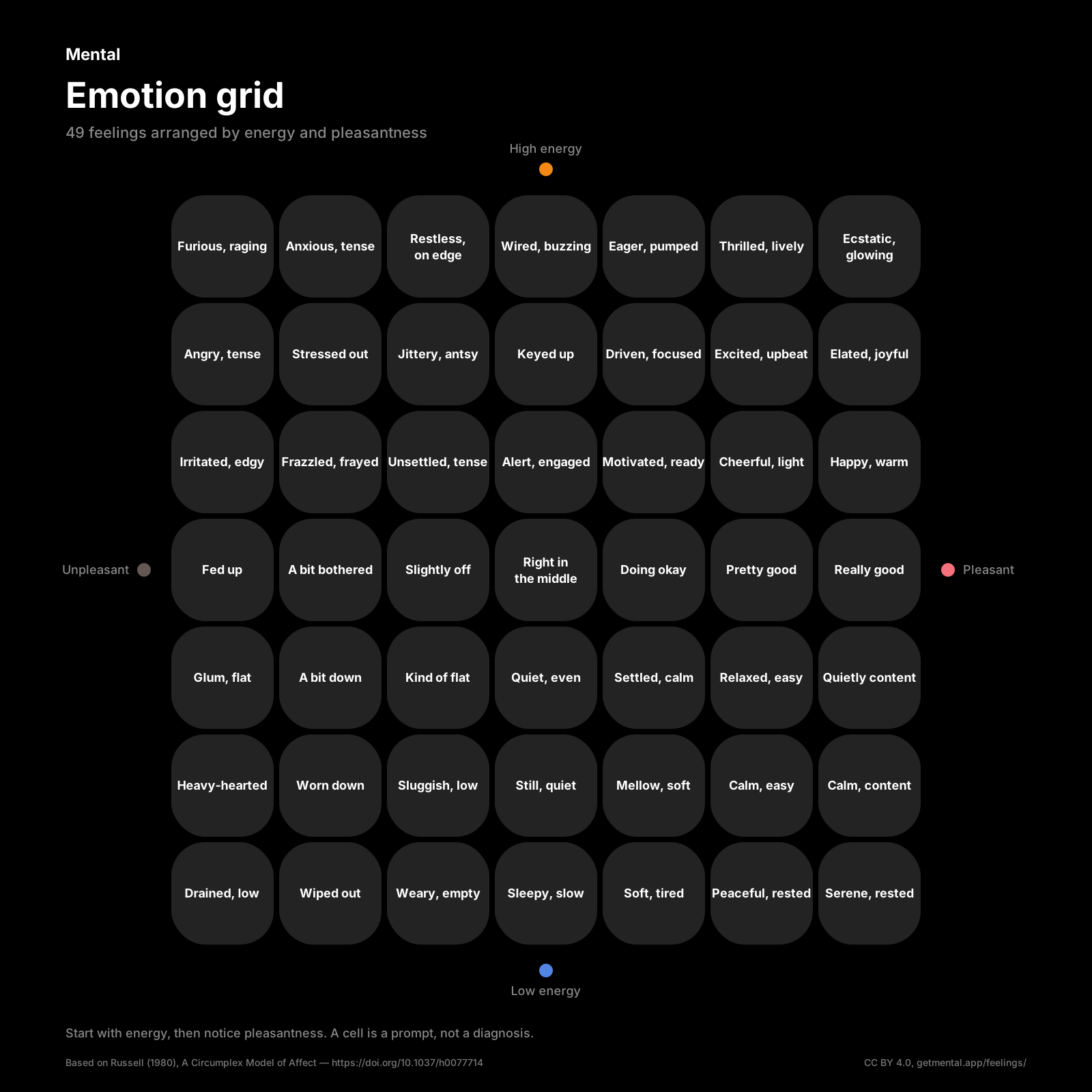
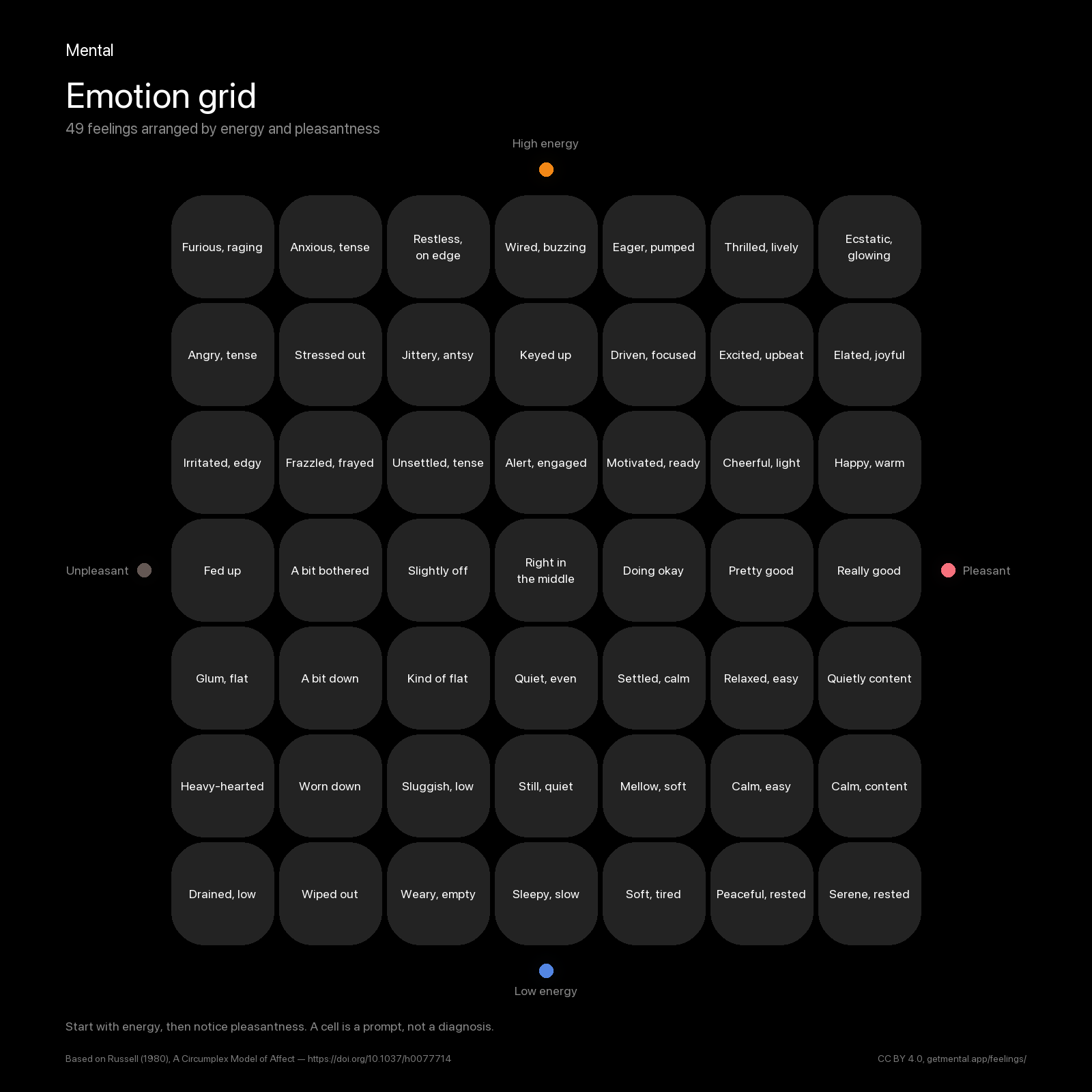
The downloadable educational assets are licensed under Creative Commons Attribution 4.0. Suggested credit: “Mental emotion grid — getmental.app/feelings/”. Attribution does not require a followed or keyword-rich link.